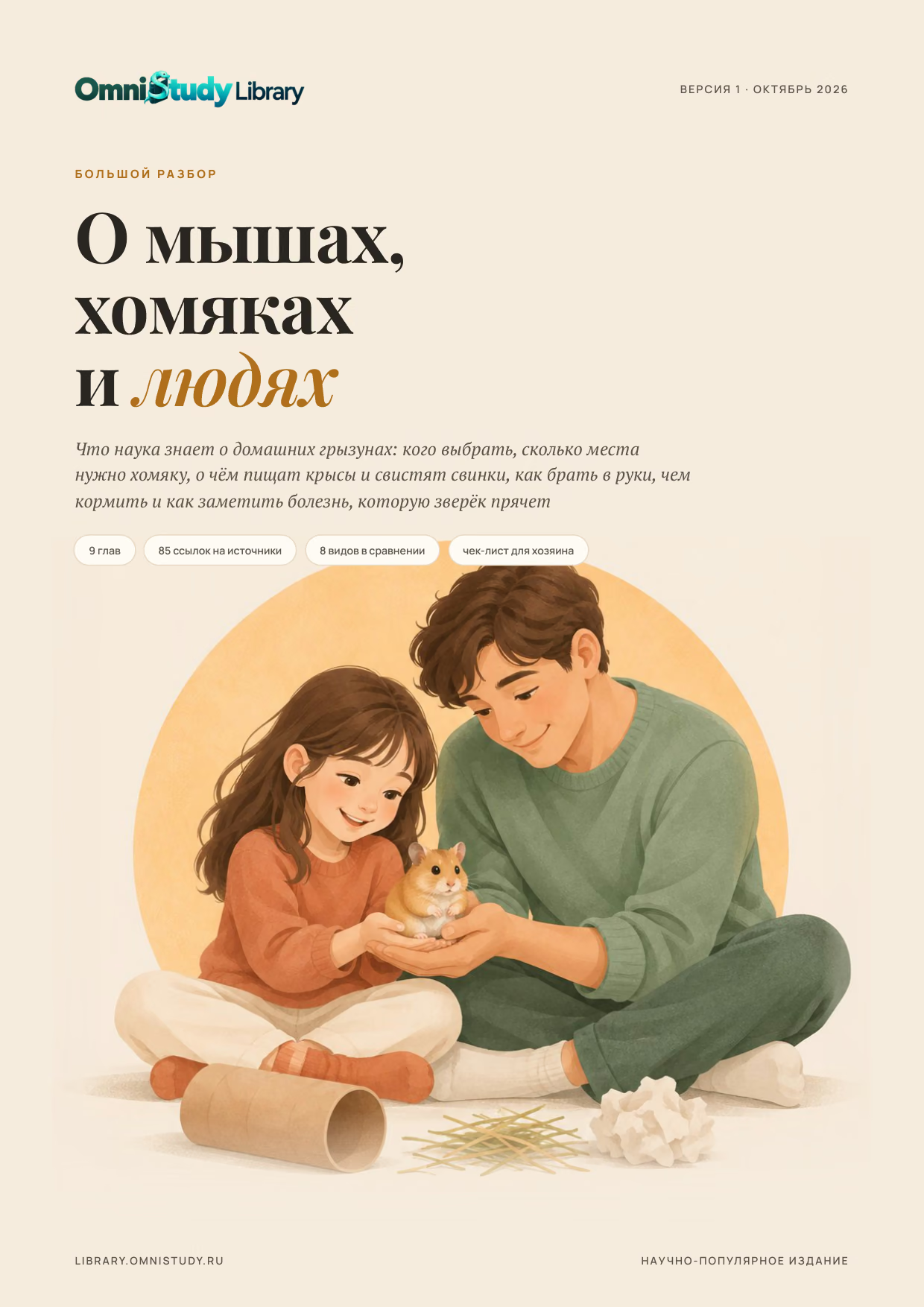
Большой разбор: что наука знает о домашних грызунах
Почти все домашние сирийские хомяки — потомки трёх зверьков из одного выводка, пойманного в Сирии в 1930 году. Морскую свинку одомашнили в Андах тысячи лет назад, а шиншилла живёт дольше иной собаки. Восемь видов — восемь характеров, и мерить их одной меркой нельзя: сирийскому хомяку сосед опасен, а свинке одиночество противопоказано. Девять глав — о происхождении и выборе вида, жилье, общении, органах чувств, приручении, зубах и питании, здоровье и сроках жизни — и десять мифов, проверенных исследованиями. Почему хомяку нужен квадратный метр и глубокая подстилка, как крысы смеются от щекотки и выпускают товарищей, почему мышь не стоит брать за хвост, зачем свинке витамин C и как по морде понять, что зверьку больно. В конце — чек-лист хозяина на день, неделю, месяц и год. Текст опирается на 85 источников: рецензируемые работы, рекомендации ветеринарных организаций и материалы ведомств. Издание не заменяет консультацию ветеринарного врача.
Формат
PDF
Страниц
24
Сложность
Новичок
Рейтинг
Новинка
Фрагмент выпуска
Страницы 2, 16–17 из 24 — текстом, как в PDF
Так начинается выпуск · Вместо предисловия
Плуг, мышь и Ленни
В ноябре 1785 года шотландский фермер Роберт Бёрнс пахал поле и плугом разворотил гнездо полевой мыши. Мышь убежала, а Бёрнс написал ей стихотворение-извинение, в котором есть строчка о том, что лучшие замыслы мышей и людей часто идут вкривь. Полтора века спустя Джон Стейнбек взял из этой строки название повести «О мышах и людях». Её герой Ленни, огромный и добрый, обожает гладить мягких зверьков — и раз за разом, не рассчитав силу, их губит.
Из выпуска · Глава 08 · с. 16–17
Молчаливые пациенты
Грызун — добыча, а добыча не показывает слабость. Болезнь становится заметной, когда зверёк уже тяжело болен. Помогают привычка наблюдать, весы, шкала гримас — и врач, к которому идут сразу.
Справочник MSD формулирует это жёстко: как добыча, грызуны не показывают явных признаков боли или болезни почти до самой смерти. RSPCA пишет то же про хомяков и свинок: зверёк может страдать задолго до того, как вы заметите, что он болен.
Отсюда главный навык хозяина — знать, как его зверёк выглядит и ведёт себя в норме, и замечать отклонения.
Лицо боли
В 2010 году канадские исследователи из Университета Макгилла под руководством Джеффри Могила создали шкалу гримас для мыши. У мыши, которой больно, меняются пять черт морды: сужаются глаза, вздувается переносица, выпячиваются щёки, уши отводятся назад, а усы меняют положение. Каждую оценивают от 0 до 2. Согласие между наблюдателями оказалось высоким, а когда опыты стали снимать камерой высокой чёткости, боль угадывали больше чем в 97 % случаев. Важная деталь: шкала хорошо ловит боль средней длительности — примерно от десяти минут до нескольких часов, но не долгую боль от повреждения нерва.
Что внутри
Девять глав и итог
От происхождения и выбора вида до зубов, болезней и сроков жизни.
Схемы и иллюстрации
Восемь видов в сравнении, шкала гримас, сколько места хомяку, как брать в руки.
Чек-лист хозяина
Что делать каждый день, неделю, месяц и год; пять вопросов перед покупкой.
85 источников
Рецензируемые работы, ветеринарные руководства и материалы ведомств — список в конце.
Что вы получите
Отзывы
Новинка
Отзывов пока нет. Оценка появится, когда выпуск оценят купившие.
Отзыв могут оставить читатели, купившие выпуск.Войти
Скачивание сразу после оплаты|Доступ навсегда|Источники в конце выпуска
Оплата — по оферте. Пока файл не скачан, деньги можно вернуть полностью.
Страницы материала
Настоящие страницы файла. «Листать» — разворотами, как книгу
Через год появилась шкала для крысы. У неё признаков четыре: нос и щёки у крысы уплощаются всегда вместе, поэтому их объединили в один, а усы при боли сбиваются вперёд в пучок.
Для сирийского хомяка шкалу тоже попробовали построить, но после операции она показала боль лишь у трёх хомяков из девяти: чувствительность у шкалы оказалась низкой, хотя авторы допускают, что сама операция болела меньше, чем ждали. Для морских свинок шкалу гримас пытались сделать, но ею почти не пользуются, а первые данные говорят, что по морде свинки боль читается плохо.
Поэтому у свинки, хомяка и шиншиллы смотрят на поведение: сгорбленная поза, взъерошенная шерсть, вялость, тяжёлое дыхание, отказ от еды.
Хомяки: мокрый хвост и короткая жизнь
Британская программа VetCompass собрала карточки 16 605 хомяков из ветеринарных клиник; почти три четверти из них — сирийские. По карточкам почти 4 000 из них самым частым диагнозом оказался «мокрый хвост».
«Мокрым хвостом» называют понос у хомяка любого возраста, но чаще всего — у молодых. Самая опасная кишечная болезнь сирийских хомячат 3–10 недель — пролиферативный илеит, его вызывает бактерия Lawsonia intracellularis, и смертность от него высокая.
Мокрая, грязная шерсть под хвостом у недавно купленного хомячка — повод ехать к врачу в тот же день. Среди смертей с известной причиной «мокрый хвост» — самый частый конкретный диагноз (7,88 %), и умирают от него совсем молодыми, в среднем в четыре месяца. Медианный возраст смерти хомяков в этой выборке — 1,75 года.
85 работ из списка в конце выпуска — авторы, год, название
1498-ФЗ, 2018. Федеральный закон от 27.12.2018 № 498-ФЗ «Об ответственном обращении с животными и о внесении изменений в отдельные законодательные акты Российской Федерации»
3Ardiles и др., 2013. Octodon degus (Molina 1782): a model in comparative biology and biomedicine. Cold Spring Harbor Protocols 2013(4): pdb.emo071357
4Bartal и др., 2011. Empathy and pro-social behavior in rats. Science 334(6061): 1427–1430
5Batchelder и др., 2012. Gerbils. В кн.: Suckow M. A., Stevens K. A., Wilson R. P. (ред.) The Laboratory Rabbit, Guinea Pig, Hamster, and Other Rodents. Academic Press, 2012, с. 1131–1155
6Berg, Kleinfeld, 2003. Rhythmic whisking by rat: retraction as well as protraction of the vibrissae is under active muscular control. Journal of Neurophysiology 89(1): 104–117
7BLV, 2018. Федеральное ведомство безопасности пищевых продуктов и ветеринарии Швейцарии (BLV). Памятки «Goldhamster im Recht», «Meerschweinchen im Recht» и др., март 2018; Tierschutzverordnung, Anhang 2
8Brudzynski, 2015. Pharmacology of ultrasonic vocalizations in adult rats: significance, call classification and neural substrate. Current Neuropharmacology 13(2): 180–192
Показать ещё 77Свернуть
9CDC, 2005. Centers for Disease Control and Prevention. MMWR: Lymphocytic choriomeningitis virus infection in organ transplant recipients (26.05.2005); Interim guidance for minimizing risk for human lymphocytic choriomeningitis virus infection associated with rodents. MMWR 54(30) (29.07.2005)
10CDC, 2024. Centers for Disease Control and Prevention. Clinical overview of rat bite fever (22.05.2024)
11Chávez и др., 2003. Retinal spectral sensitivity, fur coloration, and urine reflectance in the genus Octodon (Rodentia): implications for visual ecology. Investigative Ophthalmology & Visual Science 44(5): 2290–2296
12Cothran, 2004. Phodopus campbelli. Animal Diversity Web, University of Michigan Museum of Zoology
13De Bont, 2021. Hamster numbers: biopolitics and animal agency in the Dutch fields, circa 1870–present. History and Philosophy of the Life Sciences 43(2): 50
14Edmunson и др., 2021. Indicators of postoperative pain in Syrian hamsters (Mesocricetus auratus). Comparative Medicine 71(1): 76–85
Как сделан выпуск
Текст опирается на 85 источников: рецензируемые работы, руководства ветеринарных ассоциаций и материалы ведомств. Каждое число сверено по полному тексту работы или документа; где выборка мала или учёные спорят, это сказано в тексте. Издание носит информационный характер и не заменяет консультацию ветеринарного врача.
Редакция OmniStudy Library
Выбираете вид под свою жизнь
Кому нужна компания, кто живёт 2 года, а кто 15.
Устраиваете дом, а не клетку
Площадь, подстилка и колесо — по экспериментам и рекомендациям ветеринаров.
Приручаете без страха
Ладони, тоннель и щекотка вместо хватания сверху.
Замечаете болезнь раньше
Мокрый хвост, зубы, отказ от еды — и когда к врачу без промедления.
Для кого этот гайд
Хозяева грызунов
Кто хочет, чтобы хомяку или свинке жилось хорошо.
Родители
Кто выбирает первого питомца для ребёнка.
Кому надоели мифы
Маленькая клетка, свинка в одиночку, кролик-грызун.
15Elidio и др., 2021. Housing density and aggression in Syrian hamsters. Journal of the American Association for Laboratory Animal Science 60(5): 506–509
16Fenton и др., 2025. What are the most prevalent welfare issues for pet small mammals? Animals 15(10):
17Fischer и др., 2007. Behaviour of golden hamsters (Mesocricetus auratus) kept in four different cage sizes. Animal Welfare 16: 85–93
18Fox, Neville, 2024. Burrowing for answers: investigating Syrian hamster welfare through owner surveys. Veterinary Record 195(9): e4534
19Gaskill и др., 2012. Heat or insulation: behavioral titration of mouse preference for warmth or access to a nest. PLoS ONE 7(3): e32799
20Gattermann и др., 2008. Golden hamsters are nocturnal in captivity but diurnal in nature. Biology Letters 4(3): 253–255
21Gebhardt-Henrich и др., 2005. How does the running wheel affect the behaviour and reproduction of golden hamsters kept as pets? Applied Animal Behaviour Science 95(3–4): 199–203
22Gouveia, Hurst, 2019. Improving the practicality of using non-aversive handling methods to reduce background stress and anxiety in laboratory mice. Scientific Reports 9: 20305
23Green и др., 2018. Communication calls produced by electrical stimulation of four structures in the guinea pig brain. PLoS ONE 13(3): e0194091
24Guinness World Records, 2014. Guinness World Records. Oldest chinchilla ever (Radar)
25Harrup, Rooney, 2020. Current welfare state of pet guinea pigs in the UK. Veterinary Record 186(9): 282
26Haugg и др., 2021. Body temperature and activity adaptation of short photoperiod-exposed Djungarian hamsters (Phodopus sungorus): timing, traits, and torpor. Frontiers in Physiology 12: 626779
27Hauzenberger и др., 2006. The influence of bedding depth on behaviour in golden hamsters (Mesocricetus auratus). Applied Animal Behaviour Science 100(3–4): 280–294
28Hedley и др., 2023. Preliminary investigation into the housing of dwarf hamsters. Veterinary Record 193(4): e3170
29Heffner, Heffner, 1991. Behavioral hearing range of the chinchilla. Hearing Research 52(1): 13–16
30Heffner, Heffner, 2007. Hearing ranges of laboratory animals. Journal of the American Association for Laboratory Animal Science 46(1): 11–13
31Hennessy и др., 2015. Stability and change: stress responses and the shaping of behavioral phenotypes over the life span. Frontiers in Zoology 12(Suppl 1): S18
32Holy, Guo, 2005. Ultrasonic songs of male mice. PLoS Biology 3(12): e386
33Horn и др., 2013. Why can’t rodents vomit? A comparative behavioral, anatomical, and physiological study. PLoS ONE 8(4): e60537
35Ishiyama, Brecht, 2016. Neural correlates of ticklishness in the rat somatosensory cortex. Science 354(6313): 757–760
36Jacobs и др., 2001. Cone-based vision of rats for ultraviolet and visible lights. Journal of Experimental Biology 204(14): 2439–2446
37Kalueff и др., 2016. Neurobiology of rodent self-grooming and its value for translational neuroscience. Nature Reviews Neuroscience 17(1): 45–59
38Kerins и др., 2018. Outbreak of Seoul virus among rats and rat owners — United States and Canada, 2017. MMWR 67(4): 131–134
39Kolynchuk, 2015. Phodopus roborovskii. Animal Diversity Web, University of Michigan Museum of Zoology
40Kuhnen, 1999. The effect of cage size and enrichment on core temperature and febrile response of the golden hamster. Laboratory Animals 33(3): 221–227
41LaFollette и др., 2017. Rat tickling: a systematic review of applications, outcomes, and moderators. PLoS ONE 12(4): e0175320
42Lambert, 2025. Illuminating the shadows of neuroscience: how curiosity and courage redefine research models and mentorship. eNeuro 12(4): ENEURO.0056-25.2025
43Langford и др., 2010. Coding of facial expressions of pain in the laboratory mouse. Nature Methods 7(6): 447–449
44Legendre, 2003. Oral disorders of exotic rodents. Veterinary Clinics of North America: Exotic Animal Practice 6(3): 601–628
45Long, 2009. Pups of the degu (Octodon degus) include ultrasonic frequencies in care-eliciting calls. Proceedings of the Institute of Acoustics 31(1): 237–
46Lord и др., 2020. Ancient DNA of guinea pigs (Cavia spp.) indicates a probable new center of domestication and pathways of global distribution. Scientific Reports 10: 8901
47Makowska, Weary, 2016. The importance of burrowing, climbing and standing upright for laboratory rats. Royal Society Open Science 3(6): 160136
48Meijer, Robbers, 2014. Wheel running in the wild. Proceedings of the Royal Society B 281(1786):
49Miedel, Hankenson, 2015. Biology and diseases of hamsters. В кн.: Fox J. G. и др. (ред.) Laboratory Animal Medicine, 3rd ed. Academic Press, 2015, с. 209–245
50Modlinska, Pisula, 2020. The Norway rat, from an obnoxious pest to a laboratory pet. eLife 9: e50651
51Mota-Rojas и др., 2025. How facial expressions reveal acute pain in domestic animals with facial pain scales as a diagnostic tool. Frontiers in Veterinary Science 12:
52MSD, 2026. MSD Veterinary Manual: разделы о грызунах, хомяках, шиншиллах и морских свинках (профессиональная и для владельцев версии; обновления 2025–2026)
53Myers, Sorin, 2002. Lagomorpha. Animal Diversity Web, University of Michigan Museum of Zoology
54NC3Rs. National Centre for the Replacement, Refinement and Reduction of Animals in Research. Mouse handling
55NFRS. National Fancy Rat Society. Early domestication; History
56Niimura, 2009. Evolutionary dynamics of olfactory receptor genes in chordates: interaction between environments and genomic contents. Human Genomics 4(2): 107–118
57Nishikimi и др., 1992. Guinea pigs possess a highly mutated gene for L-gulono-gamma-lactone oxidase, the key enzyme for L-ascorbic acid biosynthesis missing in this species. Journal of Biological Chemistry 267(30): 21967–21972
58Norman, Wills, 2016. An investigation into the relationship between owner knowledge, diet, and dental disease in guinea pigs (Cavia porcellus). Animals 6(11): 73
59O’Neill и др., 2022. Demography, disorders and mortality of pet hamsters under primary veterinary care in the United Kingdom in 2016. Journal of Small Animal Practice 63(10): 747–755
60O’Neill и др., 2024. Demography, commonly diagnosed disorders and mortality of guinea pigs under primary veterinary care in the UK in 2019 — a VetCompass study. PLoS ONE 19(3): e0299464
61Panksepp, 2010. Affective neuroscience of the emotional BrainMind: evolutionary perspectives and implications for understanding depression. Dialogues in Clinical Neuroscience 12(4): 533–545
62PDSA. PDSA. Degus as pets; Hamsters as pets; Your chinchilla’s diet; Chinchilla health
63Prusky и др., 2002. Variation in visual acuity within pigmented, and between pigmented and albino rat strains. Behavioural Brain Research 136(2): 339–348
64Quesenberry и др., 2021. Ferrets, Rabbits, and Rodents: Clinical Medicine and Surgery, 4th ed. Elsevier (таблица «Biological data of pet rodents» в MSD Veterinary Manual)
66Reinhold и др., 2019. Behavioral and neural correlates of hide-and-seek in rats. Science 365(6458): 1180–1183
67RSPCA. RSPCA. Pet care advice: hamsters, guinea pigs, rats, mice, gerbils, chinchillas (разделы company, behaviour, diet, environment, health)
68Silberstein и др., 2024. Context or arousal? Function of drumming in Mongolian gerbils (Meriones unguiculatus). Frontiers in Zoology 21: 22
69Sotocinal и др., 2011. The Rat Grimace Scale: a partially automated method for quantifying pain in the laboratory rat via facial expressions. Molecular Pain 7: 55
70Steiner, Redish, 2014. Behavioral and neurophysiological correlates of regret in rat decision-making on a neuroeconomic task. Nature Neuroscience 17(7): 995–1002
71Swanson и др., 2007. Multidrug-resistant Salmonella enterica serotype Typhimurium associated with pet rodents. New England Journal of Medicine 356(1): 21–
72Sáez-Briones и др., 2026. The entactogen MDMA (3,4-methylenedioxymethamphetamine) disrupts helping behaviour while reinforcing electrophysiological indicators of potentially associated synaptic plasticity in male Sprague-Dawley rats. Frontiers in Pharmacology 17: 1779772
73TVT, 2012. Tierärztliche Vereinigung für Tierschutz. Merkblatt Nr. 153 «Chinchillas»
74TVT, 2013. Tierärztliche Vereinigung für Tierschutz. Merkblatt Nr. 158 «Mäuse»
75TVT, 2014. Tierärztliche Vereinigung für Tierschutz. Merkblätter Nr. 160 «Ratten» и Nr. 161 «Rennmäuse»
76TVT, 2020. Tierärztliche Vereinigung für Tierschutz. Merkblatt Nr. 159 «Meerschweinchen»
77TVT, 2023. Tierärztliche Vereinigung für Tierschutz. Merkblatt Nr. 154 «Degu»
78TVT, 2025. Tierärztliche Vereinigung für Tierschutz. Merkblätter Nr. 156 «Goldhamster» и Nr. 162 «Zwerghamster», апрель 2025
79van Lunteren и др., 2018. Does voluntary wheel running exist in Neotropical wild mammals? Препринт bioRxiv 409409; журнальная версия — acta ethologica 24(1): 23–30 (2021), числа аннотации совпадают
80Veillette и др., 2010. Cause and possible treatments of foot lesions in captive Syrian hamsters (Mesocricetus auratus). Veterinary Medicine International 2010: 951708
81Vergara, 2022. From wilderness to breeding farms: the domestication of Chinchilla lanigera. Arcadia (Rachel Carson Center), 2022, no. 15. doi:10.5282/rcc/9531
82Vergneau-Grosset и др., 2016. Description of the prevalence, histologic characteristics, concomitant abnormalities, and outcomes of mammary gland tumors in companion rats (Rattus norvegicus): 100 cases (1990–2015). Journal of the American Veterinary Medical Association 249(10): 1170–1179 (авторская версия, eScholarship)
83Waiblinger, König, 2007. Housing and husbandry conditions affect stereotypic behaviour in laboratory gerbils. ALTEX 24 (Special Issue): 67–69
84Wilson и др., 2017. Golden Hamster Mesocricetus auratus. В кн.: Handbook of the Mammals of the World, vol. 7: Rodents II. Lynx Edicions, 2017, с. 282
85Правительство РФ, 2025. Распоряжение Правительства РФ от 08.05.2025 № 1163-р: перечень животных, запрещённых к содержанию